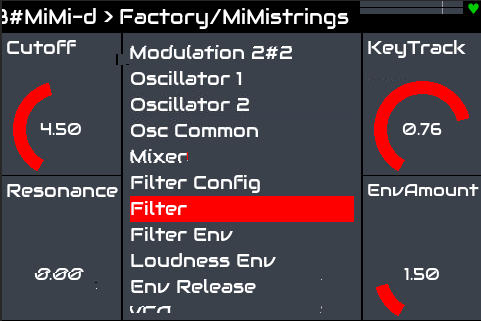
Filter page of the MiMi-d Virtual Analog Plugin, running on the Zynthian platform
For a while I've been checking out various, mostly free, synthesizers in plugin form. However, after a while I get itchy fingers, wanting to change things or fix deficiencies. However, that would create a similar but incompatible instrument, so I've had the thought of designing my own virtual analog synthesizer for some time.
Queue the OB-Xd, which is a widely acclaimed Open Source virtual analog rendering of the Oberheim OB-X polyphonic analog synthesizer.
As people who know me will attest, Oberheim synths are not my favorites, but the OB-Xd has a number of interesting traits:
So, I looked into using the OB-Xd as a starting point to create a digital synthesizer plugin. Basically, the idea was to keep the DSP code with a few modifications, and some typical Pollux features added (see below).
The first goal is to create a plugin for the Zynthian platform, using the native Zynthian GUI with four knobs per parameter page.
The instrument implements a fairly basic two oscillator synthesizer, with the idea of keeping the number of parameters low, so that it's possible to grasp the instrument easily, thus being more inviting to create sounds on. In essence, it is a combination of the best ideas from the Delta Seven and MiMi-a synthesizers, in digital form.
The manual can be found in the github repository (see below), or here.

Note that there is no preset/patch management in the GUI, which instead relies on the plugin host to handle this. When running in Jalv (above) Jalv adds preset management in the form of a Presets menu. VST3 and AU hosts generally manage presets themselves as well.
New since version 2.4.3: The MacOS version now includes both VST3
and AU format plugins.
New since version 2.4.4: Windows VST3 support (Intel only).
Version 2.4.3
for MacOS (Intel and ARM) (VST3 and AU, including installation instructions)
Version 2.4.4 for Windows (Intel) (VST3)
Version 2.4.3 for X86-64 (Intel and AMD) Linux (LV2 and VST3: .deb and .rpm packages)
Version 2.4.3 for ARM64 Linux (LV2 and VST3 .deb and .rpm packages)
OB-Xd uses the JUCE 5 framework for audio plugins, and thus MiMi-d did that too
originally, in the form of a
fork
(
dev-mimid branch)
of the DISTRHO-Ports repository of Linux synthesizer plugins,
which is what is used in Zynthian for the OB-Xd (and several other
software synths) implementation.
(A
separate branch of a
fork of the zynthian-data repository contained the
.ttl file (GUI parameter definition file), in a similar manner to the OB-Xa
.ttl file).
Development has since migrated to use the
DISTRHO Plugin Framework (DPF), which is falkTX's lightweight framework for
developing Linux audio plugins.
The repository is found at
https://github.com/polluxsynth/audio-plugins.
Development takes place on the
dev branch
with the
master branch
containing finalized changes and releases (with appropriate git tags).
Beware that I tend to rebase the dev branch often.
The latest release at the time of writing is 2.4.4 . Functionally it is
identical to 2.4.3, but adds support for Windows VST3, which in turn is
identical to 2.4.2, but with support MacOS AU format plugin.
Development
MiMi-d is a software-only synthesizer, in the shape of a Linux LV2 plugin,
written in the C++ programming language.
Development-wise, it started with the OB-Xd code base, and then over time
was evolved to become the MiMi-d.
Back to my synth page.